May is Melanoma and Skin Cancer Awareness Month
Please join with AACR to find better ways to prevent and treat skin cancer and melanoma
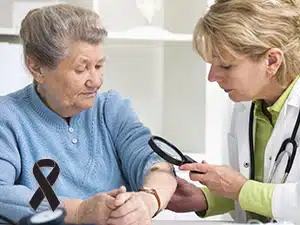
The skin cancer category includes melanoma, basal cell skin cancer, and squamous cell skin cancer.
Skin cancer is a very common cancer in the United States. More than 6 million people receive such a diagnosis each year. Basal cell carcinoma and squamous cell carcinoma, which are nonmelanoma skin cancers, are the most common types of skin cancer. Nonmelanoma skin cancers rarely spread to other parts of the body.
Melanoma, however, is an aggressive form of skin cancer. It is more likely to invade nearby tissues and spread to other parts of the body than the more common forms of skin cancer.
According to estimates made from the National Cancer Institute’s Surveillance, Epidemiology, and End Results (SEER) Program, 112,000 Americans will be diagnosed with melanoma and about 8,510 people will die of the disease in 2026.
Melanoma is more common in men than women and among individuals of fair complexion. Unusual moles, exposure to natural sunlight or artificial sunlight (such as from tanning beds) over long periods of time, and family history can affect the risk of melanoma.
Melanoma usually occurs in the skin. But it also occurs in mucous membranes, the thin, moist layers of tissue that cover surfaces such as the lips. If melanoma occurs in the eye, it’s called intraocular or uveal melanoma.
One Person’s Story
Jennifer Ficko was diagnosed with stage 4 melanoma in 2010, and over the next few years, she was given treatments that her cancer either didn’t respond to or caused severe side effects. A turning point came in 2017 when her oncologist, Dr. Harriet Kluger, recommended she participate in a clinical trial evaluating a novel immunotherapy known as tumor-infiltrating lymphocyte (TIL) therapy. Now, she is cancer free. Read more about Jennifer’s story in the 2024 AACR Cancer Progress Report.
The latest on melanoma and skin cancer
- Lifileucel became the first TIL therapy approved for clinical use when the U.S. Food and Drug Administration cleared it for unresectable or metastatic melanoma. Learn more about the decades of research behind this therapy on the official AACR blog, Cancer Research Catalyst.
- People with metastatic melanoma who received a messenger RNA (mRNA)-based COVID-19 vaccine around the time they started immunotherapy lived significantly longer than patients who did not receive a vaccine, according to a new study. Learn more about how mRNA-based vaccines helped prompt immune responses to attack tumors in the AACR magazine Cancer Today.
- Many regions around the world lack expert pathologists capable of reviewing samples to diagnose nonmelanoma skin cancer quickly. To help with this, researchers have developed AI-based models capable of helping to diagnose nonmelanoma skin cancer in resource-limited settings. Learn more on Cancer Research Catalyst.
- Those treated for childhood cancers often live with long-term side effects and health risks as adults, and according to a recent study, these include a risk of developing melanoma that is more than double the risk in the general population. Read more in Cancer Today.
What AACR Is Doing in Skin Cancer Research
The AACR supports several researchers for their work in the field of skin cancer:
- Aaron Matthew Newman, PhD, of Stanford University, received an AACR Trailblazer Research Grant for Mid-Career Investigators for his work on the real-time profiling of tumor microenvironment dynamics to decode immunotherapy response in melanoma.
- Amanda Truong, MD, PhD, of the University of California, Los Angeles, was a recipient of AACR Conquer Cancer®, the ASCO Foundation Young Investigator Award for Translational Cancer Research, in 2026. Her work is exploring how to leverage desmoplastic melanoma signatures to enhance immunotherapy response.
- Alexander Huang, MD, of the University of Pennsylvania, received the Friends of the AACR Foundation Party with a Purpose Early Career Investigator Award to aid his research on understanding the immune determinants for efficacy of TIL therapy in human melanoma.
for more information
Please see AACR’s page on melanoma and skin cancer for more information on these diseases and their prevention, screening, and treatment.

Your gift helps the American Association for Cancer Research fund pioneering science that is saving lives every day.
Donate Now
There are many ways in which you can lend your talents to support lifesaving research. Learn how you can become an advocate for cancer research, participate in events to raise awareness, volunteer your time, and share your story of how cancer has affected your life.
Get Involved